8:00 a.m -6:00 p.m
-
-
-
RMZ Ecoworld, Bellandur, Outer Ring Road
8:00 a.m -6:00 p.m
RMZ Ecoworld, Bellandur, Outer Ring Road
Maybe you were coping. You went back to work, replied to the condolence messages and sat through the prayers. Then, one ordinary evening, you found her handwriting on an old grocery list and had to sit down on the kitchen floor.
Grief rarely keeps to the schedule other people expect, and it almost never moves in a straight line. The 7 stages of grief give you words for what you may be feeling. They are most useful as a map of common experiences, and least useful as a checklist you are supposed to finish in order.
Below you will find each stage, where the model came from, what researchers have learned about how grief really changes over time, and the signs that grief needs more support than time alone can give.
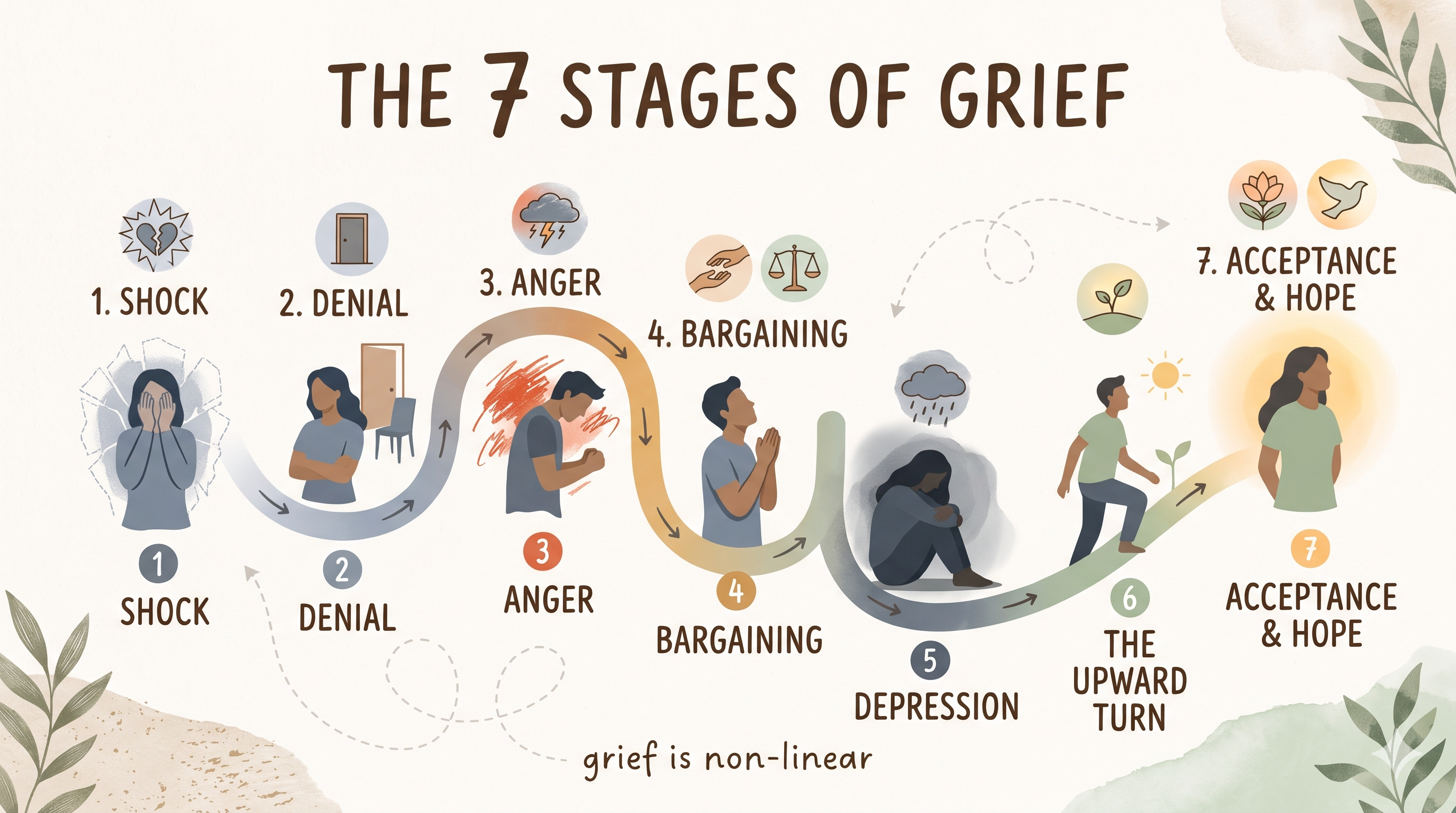
In the order they are usually listed, the 7 stages of grief are:
A second seven-stage list also circulates: shock, denial, anger, bargaining, depression, testing and acceptance. Both cover much the same ground. Neither one is a clinical model, and nobody moves through either list neatly.
Grief stages trace back to the psychiatrist Elisabeth Kübler-Ross. In her 1969 book On Death and Dying she described five stages (denial, anger, bargaining, depression and acceptance), drawn from interviews with people who were themselves dying of a terminal illness. Her subject was facing your own death. Mourning someone else came later.
Decades on, Kübler-Ross and the grief specialist David Kessler applied the stages to bereavement in On Grief and Grieving (2005). In that book they wrote that the stages were never stops on a linear timeline, and that not everyone goes through all of them (Frontiers in Psychology review). Kessler later proposed a sixth stage, finding meaning, in a 2019 book shaped by the death of his own son (Finding Meaning).
Seven-stage versions expand the original list. People like them because they name feelings the five stages leave out, guilt above all. There is little research support for the seven-stage model itself.
| Model | Stages | Where it comes from |
|---|---|---|
| Five stages | Denial, anger, bargaining, depression, acceptance | Kübler-Ross, On Death and Dying (1969), written about dying patients |
| Seven stages, common version | Shock and denial, pain and guilt, anger and bargaining, depression and loneliness, the upward turn, reconstruction, acceptance and hope | Grief-support writing that builds on Kübler-Ross |
| Seven stages, extended version | Shock, denial, anger, bargaining, depression, testing, acceptance | Adds shock and testing to the original five |
| Six stages | The five stages plus finding meaning | David Kessler, Finding Meaning (2019) |
The first hours and days after a loss often feel unreal. Some people sob. Many feel almost nothing, and are surprised at how calm they sound while they phone relatives, arrange the cremation or burial and answer the same questions over and over. You might pick up your phone to tell them something, then remember.
That numbness protects you. It lets the reality in a little at a time.
For now, let other people handle as much of the logistics as they can. Eat something, drink water and lie down even if sleep will not come. You do not have to feel any particular way yet.
When the numbness wears off, the pain arrives, and it is often physical: a tight chest, a body that feels heavy, crying that starts out of nowhere. Guilt tends to come along with it. If only I had pushed for a second opinion. I should have called more often. I was not there at the end.
If you were the one handling the hospital visits and the medicines, guilt can attach itself to every decision you made. After a long illness you may also feel relief, followed quickly by guilt about the relief. Plenty of people feel relieved after watching someone suffer, and it says nothing about how much you loved them.
Saying the guilt out loud helps, ideally to someone who will listen before trying to argue you out of it. It also helps to separate what you knew at the time from what you know now.
Anger can point in any direction: at the doctors, at God, at the relative who said the wrong thing, at the person who died, at yourself. Many women grow up hearing that anger is ugly or ungrateful, so it may leak out sideways instead, as snapping at the children or a short fuse at work.
Bargaining is the voice saying what if and if only. Your mind replays the story, hunting for the moment it could have gone another way. Some people keep bargaining with God even after the death.
Neither feeling burns out fast. In the Yale Bereavement Study, which followed 233 people after a family member died of natural causes, anger was at its highest around five months after the loss (Dana-Farber summary).
Anger needs an outlet: a fast walk, hard physical work, a letter you never post. When a what-if loop starts, try naming it ("I'm bargaining again") and then bring your attention back to today.
This stage often arrives once everyone else has gone back to their lives. The relatives leave after the thirteenth day or the fortieth, the phone goes quiet, and you are alone in a house that still has their slippers by the door.
The sadness now is heavy and slow. You may pull away from people, lose interest in food and spend long hours going over old memories. All of that belongs to ordinary grief. Clinical depression is a different condition, although the two can overlap.
A little structure goes a long way here, even if it is only one fixed mealtime and a short walk each day. Find one person you can be completely honest with, and keep an eye on the warning signs listed further down.
At some point, often without noticing, you have a slightly better day. You laugh at something. You sleep through the night. The pain is still there, though its edges have dulled.
Guilt can show up here too, as though feeling better meant betraying them. Feeling better is allowed. And a terrible day after a good week does not send you back to the start.
Let the good moments count. You do not owe anyone an explanation for them.
Now the practical work of living without the person begins in earnest. You may be learning to deal with money, property papers or insurance claims they used to manage. You may be taking on a new role: the one who cares for an ageing parent, the single parent, the person who now runs the household.
The extended seven-stage list calls this testing. You try things out. Some of them work and some do not, which is part of the process.
Take one task at a time. Ask for specific help ("Can you come with me to the bank on Friday?") rather than waiting for people to offer.
Acceptance means the loss has become part of your story. It no longer ambushes you every hour. You can still hate that it happened, and you can think of them and feel love alongside the pain.
Many people keep a bond with the person who died, through prayer, a yearly ritual, cooking their recipes or talking to them on hard days. Hope returns slowly, usually as small plans for the future that carry their memory with you.
The trouble with the 7 stages of grief, or any stage model, is how people use it. They hear "stages", assume one must be finished before the next can start, and then worry that they are grieving wrongly. Kübler-Ross herself rejected the idea of a tidy sequence, and the research supports her.
In 2007 a team from Yale published the first study to test stage theory against real data, in the Journal of the American Medical Association (PubMed abstract). They followed 233 people for up to two years after a family member died of natural causes.
Part of what they found fits the stages. Each feeling peaked in roughly the predicted order: disbelief first, yearning at about four months, anger at about five and depression at about six. The overall picture, though, looked nothing like a staircase:
So the feelings overlap. You can accept that your father has died and still ache for him every day.
The dual process model, published by the grief researchers Margaret Stroebe and Henk Schut in 1999, describes grief as a back-and-forth between two kinds of coping (Utrecht University record):
Healthy grieving, in their view, moves between the two. An afternoon watching a film with friends counts as coping too. Problems tend to start when someone gets stuck at one end, either grieving all the time or refusing to grieve at all.
Grief can return in a rush, even years later. Common triggers include:
A wave after a good stretch leaves your progress intact. This is simply how grief behaves.

The stages are usually listed in this order, but a reminder such as an anniversary or the first festival without them can bring back feelings from an earlier stage, even after a good stretch.
Loss affects your body as well as your feelings. When researchers at Harvard and Beth Israel Deaconess Medical Center studied nearly 2,000 heart attack patients, they found that heart attack risk was about 21 times higher than normal in the 24 hours after the death of someone close, and stayed several times higher through the first week (Harvard T.H. Chan School of Public Health).
Women carry an added risk. Takotsubo syndrome, often called broken heart syndrome, is a sudden weakening of the heart muscle that can follow severe emotional stress, including bereavement. Around 90% of the people who develop it are women past menopause, and it can feel exactly like a heart attack (British Journal of Cardiology).
If you, or anyone grieving, has chest pain, breathlessness, or pain spreading to the arm, jaw or back, go to an emergency department. Please do not write it off as stress.
The more everyday physical signs of grief include poor sleep, appetite changes, exhaustion, headaches, stomach trouble and a foggy, forgetful mind. Slow breathing, walking and other body-based practices can help a stressed nervous system settle, and our guide to regulating your nervous system is a good place to begin.
You can move through the 7 stages of grief without anyone having died. Many of the same feelings follow:
Some of these losses get very little recognition. Nobody holds a prayer meeting for a miscarriage, and few people bring food after a divorce. Grief that others fail to acknowledge, sometimes called disenfranchised grief, can be lonelier and harder to talk about. It still counts as grief.
Mourning in India usually comes with structure: the rituals, the thirteenth day, the fortieth day, the first death anniversary, a house full of relatives in the early weeks. That structure can be a comfort. It can also make things harder, because the emotional timeline rarely lines up with the ritual one. Once the formal mourning period ends, many women find their grief is only starting, just as everyone around them expects life to go back to normal.
Women are often the ones keeping the household going while relatives stay, cooking for mourners and looking after children and elderly parents. That leaves little room to grieve. A woman who loses her husband may also face sudden financial responsibility and, in some communities, a change in social standing that adds shame or isolation on top of the loss.
If any of this sounds familiar, your grief is neither slow nor excessive. You may just not have had the space to feel it yet.
Grief has no fixed timeline. For many people the most intense pain eases within the first year or two (Medical News Today), after which grief becomes something they carry rather than something that runs their days. Anniversaries and big life events can stir it up for years.
In the Yale study, the painful feelings generally peaked within about six months. The researchers suggested that people still scoring high on them after six months could benefit from a professional assessment.
Sometimes grief does not ease. Prolonged grief disorder has been an official diagnosis in the American Psychiatric Association's DSM-5-TR since 2022. It can be diagnosed when, at least 12 months after a death (six months for children and teenagers), someone still has an intense grief response most days that disrupts their life (World Psychiatry, 2021). The World Health Organization's ICD-11 sets the minimum at six months (Frontiers in Psychiatry, 2024).
Clinicians look for signs such as:
A review of 14 studies estimated that about one in ten adults bereaved by natural causes develops prolonged grief disorder (Lundorff et al., 2017). After unnatural deaths such as accidents, suicide or homicide, a later review put the figure at nearly half (Djelantik et al., 2020).
If you are thinking about ending your life, please call Tele-MANAS, the Government of India's free 24/7 mental health helpline, on 14416 or 1-800-891-4416 (National Tele Mental Health Programme), or go to your nearest emergency department. Manushee is not a crisis service. You will find more helpline numbers on our contact page.
Manushee is a women's-only practice. Our grief and loss support covers bereavement, end-of-life support for families, and the losses other people may not recognise.
Care usually begins with an Integrated Nervous System Profile, which shows how grief is affecting your sleep, hormones, body and relationships as well as your mood. Therapy then draws on our four essential pillars: Somatic Experiencing, Internal Family Systems, attachment-focused therapy and functional medicine. Somatic and parts-based work can help when grief feels stuck in the body or knotted up with guilt. The research behind these approaches for grief is smaller than for structured grief therapies, and we will be honest with you about what suits your situation.
If grief has settled into persistent low mood, read about our work with depressive disorders. If the death was traumatic, our page on trauma and CPTSD explains how we help. Wherever you are in the 7 stages of grief, you can meet our team and book a free discovery call.

